Before You Sign: Seven Questions That Separate Real Tracking Platforms from Demo Ware
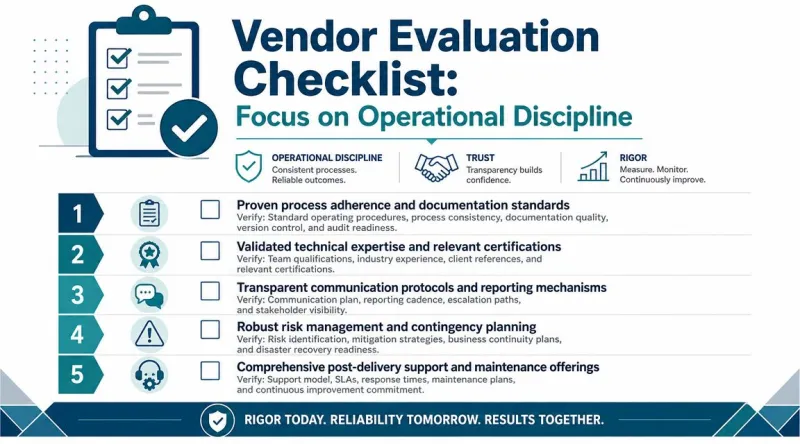
Photo: procurement team evaluating software vendor checklist conference room, via sheridantech.io
Every SaaS demo follows the same arc: a clean interface, a pre-loaded dataset, a workflow that seems tailor-made for your business. It should — it was built for the demo. The real evaluation starts when the sales engineer closes the tab and your procurement team starts asking harder questions.
Below are seven we recommend bringing into every vendor conversation. They're ordered roughly by how often they prevent an expensive mistake.
1. How deep does the integration actually go?
"We integrate with Salesforce" can mean a native, bidirectional sync or a one-way CSV export that runs nightly. Ask which fields sync, in which direction, and what happens when a record conflicts. Then ask for a reference customer with a stack similar to yours — not a logo, a stack.
2. What does week three of adoption look like?
Every tool gets used enthusiastically in week one. The question is what happens when the novelty wears off. Ask vendors to describe their onboarding program beyond the kickoff call, and ask specifically: what percentage of customers are still actively using the platform at 90 days? A vendor that can't or won't answer that number is telling you something.
3. Can we see a complete audit trail, not just a change log?
For US buyers in regulated industries — healthcare, finance, government contracting — audit capability is a purchase criterion, not a feature. Distinguish between a change log (what changed) and a true audit trail (who changed it, when, from where, and what the previous value was). The difference matters in an audit and in a dispute.
4. Who owns the data, and how do we get it out?
Exit costs are the most underestimated line in any SaaS contract. Ask for the export format, the export frequency available to you mid-contract (not just at termination), and whether the vendor charges for it. A platform confident in its value makes leaving easy. One that doesn't has answered your question.
5. What does the pricing look like at twice our size?
Per-seat pricing that looks reasonable at 40 users can be punishing at 90. Model your three-year cost at your realistic growth trajectory, including any tier jumps, API call limits, or "enterprise feature" gates. Get it in writing.
6. What breaks when we customize?
Every operations team customizes eventually. The question is whether those customizations survive product updates or become maintenance liabilities. Ask how the vendor handles breaking changes, what their deprecation policy is, and how much notice customers get.
7. What does this platform replace — and what does it duplicate?
The hidden cost of a new tracking tool is rarely the subscription; it's the overlap. Map the new platform against your existing tools honestly. If it duplicates 60% of a system you're keeping, you're paying twice for the same capability and training your team on both.
Bring a Scorecard, Not a Vibe
The single biggest improvement a procurement team can make is scoring vendors consistently rather than comparing impressions. Rate each candidate 1–5 on the seven questions above, weight them by your priorities — a regulated manufacturer should weight audit trails heavily; a fast-scaling agency should weight pricing at scale — and let the math inform the conversation rather than replace it.
No platform will ace all seven. But the pattern of where a vendor hesitates tells you more than any demo ever will. Hesitation on integration depth predicts implementation pain. Hesitation on exit terms predicts lock-in. Hesitation on adoption metrics predicts shelfware.
Track smarter, work better — but first, buy smarter.